Saturday, November 13, 2021

Document Decoding: Phyllis Jean Ver Hoef's Church Transfer

In a previous post, I discussed how in the Protestant world, Church and even denominational transfers were not unusual. Here is another example, this time for my maternal grandmother, Phyllis Jean Ver Hoef (granddaughter of Fred Wise and Jeanette Harkema, the couple mentioned in my previous post). 


My maternal grandparents, Alvin John TerVree Jr. and Phyllis Jean Ver Hoef, married on March 19, 1965, at First United Methodist Church in Holland. This was Phyllis's childhood church, and as it was the custom to marry in the wife's church, my grandparents married there. However they began attending First Reformed Church, my grandfather's church, after their marriage, as it was closer to home. Once they moved to the north side, they joined Fellowship Reformed Church, where my mother was baptized and my grandfather still attends. 

What is the meaning of all this? It means my maternal grandmother, Phyllis Jean Ver Hoef, grew up Methodist. She married my grandfather, Alvin John TerVree Jr., who was of the Reformed Church in America, in the Methodist Church, due to custom, and then upon marriage she joined the RCA herself. Again, church transfers happen all the time in the Protestant world. 

Obituary Observations: Ethel Clemons of Haywood, Tennessee; Winter Haven, Florida; and South Haven, Michigan (1923-2011)

My great-grandmother, Ethel Clemons, was the only great-grandparent that I met on my father's side, and is one of the best remembered ancestors I have. My paternal grandmother (Ethel's daughter) was very close to her, and the rest of her family seems to have been as well. While I do not remember Ethel all that well, I definitely had a great many interactions with her. While her obituary was quite short, it does a very good job at summarizing her life. 

Transcription: 

Ethel Betz, 87, of South Haven. God called his sweetest angel home on Friday, August 4th at the South Haven Nursing and Rehabilitation Community.

She was born September 26, 1923 in Brownsville, Texas to Frank and Cordie (Humpreys) Clemons. She lived most of her life in the South Haven area. Ethel worked many years at the former Bangor Electric. She was a devoted homemaker and mother. Ethel loved to travel and play board games with family and friends. Her greatest treasure was her family. Our miss Ethel was dearly loved and will be greatly missed.

She is preceded in death by her parents, two sisters and one brother.

She is survived by two daughters – Linda Casey of South Haven, Michigan and Sandy (Tony) Auippy of Florida. Four grandchildren – Brian (Amy) Winn of Holland, Greg Biggs of South Haven, Michigan, Angel (Brian) Dicken of Zeeland, Michigan and Chris Aiuppy of Houston, Texas. Five great-grandchildren and two great great grandchildren. Two sisters – Peggy Moon and Pat Dingler both of Texas.

A memorial service will be scheduled at a later date. Kindly share your thoughts and memories on the family’s online guest book at www.FilbrandtFFH.com.

The family is being helped by the Filbrandt Family Funeral Home of South Haven 637-0333.

Here are some of my observations: 
  • Ethel is listed with her final married name, Betz. She was divorced from my great-grandfather, John Washington Winn Jr., sometime around 1967, due to his infidelity. She eventually remarried to Edward Betz, who had served in the Navy. Although my paternal grandmother remembers him quite well, I have never seen a picture of him and know nothing else about him besides that he served in the Navy. 
  • The place of death is listed, the South Haven Nursing and Rehabilitation Community in South Haven, Van Buren County, Michigan. 
  • While the 26th of September is listed as her date of birth, and that is the day she celebrated it as, she was actually born on the 21st of September. The reason for the discrepancy? The family didn't file her birth until the 26th. Due to being born in very rural Tennessee, the Clemons family probably lived very far from the appropriate place to register her birth. Still, I find it odd that she celebrated her birthday as the 26th. 
  • The obituary includes a very glaring error- she was actually born in Tennessee, not Texas. If she had been born in Brownsville, Texas, I would have wondered if Ethel was partially Tejano. In fact, when I first began researching my ancestry and found this obituary, that was my suspicion, until a quick conversation with my grandmother dispelled that idea. 
  • Her parents are named, Frank and Cordie (Humphreys) Clemons. Ethel was always closer to her mother, Cordie, who lived longer then her father, Frank, an orphan who I know very little about. Frank is the only one of my seize quartiers whose parentage is unknown, meaning Ethel is my only great-grandparent, who I do not know all 4 grandparents of. 
  • It is stated that she lived most of her life in the South Haven area. Ethel moved to Michigan with her husband John sometime in the early 1950s, when she was probably around 30, and she lived in the area until her death in 2011, so this makes sense. 
  • Her place of work is mentioned, Bangor Electric. I know very little about this place, and she retired before I was born. It likely was an electric company in Bangor (a city where the family lived), although I can't be sure. I know that before this, when she lived in Florida, she had worked at a drugstore, and met some celebrity, but I don't know much else. 
  • Ethel is described as a "devoted homemaker and mother". All of her living family describes her as such, and my mother tells me how friendly she was, so this sounds accurate. 
  • Maybe my paternal grandmother's infamous love of travel comes from Ethel! My grandmother has been all over the United States, and it would make sense that Ethel loved travelling too. My mother recalls that Ethel and my grandmother went to places like Branson, Missouri and Elvis's home. Her love of Elvis is the main thing I remember about her. When my grandmother was having a garage sale at her old house, I bought one of her old Elvis pillowcases and was told this fact. Apparently she had a ton of Elvis stuff. 
  • I did not know that Ethel loved board games, but it seems to match her personality. 
  • The two sisters and brothers mentioned are Bonnie Mildred, Josephine, and Harold. The obituary doesn't mention Ethel's brother Frank Clemons Jr., who died at eight days old in 1927. He probably wasn't spoken of much. 
  • All the surviving relatives have residences listed, which is important for genealogical research and unraveling familial connections. 
  • The two living siblings, Peggy and Pat, have been reduced to one, since Pat died in 2014. Peggy is still alive, but very elderly. They both moved to Texas later in life, and many of my great-grandmother's relatives down there are currently Jehovah's Witnesses. 
Obituaries like this are short and simple, but pack a lot of genealogical information. 

"If you aren't Dutch..." well, neither am I

One of my favorite blogs is the very simply named "Dutch Genealogy". My mother's family is of mostly Dutch American descent, so a lot of my research outside of the United States is based on ancestors from the Netherlands. And in doing research on my Dutch ancestry, I have learned a lot of interesting facts about the history, culture, and society of the old country. For example, that a majority of Dutch citizens today, even among the ethnic Dutch, have ancestors who immigrated to the Netherlands from other parts of Europe or from across the world (such as the former Dutch Colonies of Indonesia, Suriname, etc.). I have known this fact for a long time, but it has begun to sink in more recently as I have proven four different lines, where my Dutch immigrant ancestors, themselves descended from immigrants to the Netherlands from other parts of Europe. And besides my four proven lines, there are also rumors on a few others. 

Lineage 1: Brussels, Belgium to Goes, Zeeland, Netherlands: My 4th great grandfather, Jan François Joseph Fredrik Goossen, was a Dutch Reformed Schilder (House Painter) who immigrated to Chicago, Illinois in 1854 from Goes, a city on Zuid-Beveland in the southwestern Province of Zeeland. While Jan's father, François Goossen, was from a well-established family of Zeeland Protestants, Jan's mother, Maria Louisa Everard, was a Roman Catholic. Maria was an immigrant to Goes from the heavily Catholic Belgian Capital of Brussels. This is proven by the 1812 Census of Goes (Maria Louisa Everard, geboren op 12 november 1798 te Brussel, gehuwd, Rooms-Katholiek) and her death record, which lists her place of birth as Brussels. Her extant baptism record shows that she was baptized on November 12, 1790 at the Brussels Catholic Church known as Saint Géry/Sint-Gorik, which was destroyed during the French Revolution only a few years later. The Catholic Parish Records in Brussels, which are written in Latin, allow Maria's ancestry to be traced back a few generations in Brussels, and possibly several more generations in Merchtem and Buggenhout, two other Flemish cities. I think it is very interesting that Maria, a Roman Catholic, immigrated to Goes and married into a Dutch Reformed family. According to the famed historian Robert P. Swierenga: "The most important characteristic of Old Zeeland was its religious conservatism. Protestants there had the reputation for being arch conservatives and traditionalists. They were echte Calvinisten, genuine Calvinists and staunch defenders of the old creeds. Zeeland was the heart of the "Bible-belt" in the Netherlands that stretched inland "between the Rivers" to Gelderland". Sure, it is possible that Maria had converted to the Dutch Reformed Church, but her 1812 Census record implies she kept the Catholic Faith. Her mother was still alive in Brussels, so her reason for immigrating is unknown. If she remained a Roman Catholic, I wonder how her husband François was looked upon for marrying a Catholic. Presumably, this wasn't a very popular thing in devoutly Calvinist circles. These questions will remain, but the fact is, this Zeeland family had an immigrant ancestor from Belgium. 

Lineage 2: Echzell, Hesse, Germany to Elburg, Gelderland, Netherlands: My 5th great grandfather, Willem Stephan, was a blacksmith who immigrated to Holland, Michigan in 1873 from Harderwijk, a city in the Veluwe in the Province of Gelderland (interestingly, Harderwijk is at almost the exact geographic centre of the Netherlands). Willem's paternal grandfather was Johan Phillip Stephan, a sailor and immigrant to Elburg, a city in Gelderland, from Echzell, a municipality in the modern-day State of Hesse, Germany. This is proven by his marriage and death records, which list his place of birth as Bingenheim (an ortsteil of Echzell). The 1812 Census of Elburg provides his date of birth, which, along with his death record, which lists his parents, allows us to find his origin in Germany, and trace back his ancestry for a few generations. Supposedly, he was a Prussian Sailor who deserted and moved to Elburg. One online tree references the 1787 Prussian military campaign in the Netherlands to restore the Stadtholderate of the House of Orange to power, during the political discontent of the Patriottentijd. Maybe he was involved in this campaign, and ended up settling permanently in the Netherlands. While I cannot verify this story, the fact is, the Stephan family of Gelderland had an immigrant ancestor from Germany, or at that time, the Holy Roman Empire. 

Lineage 3: Burgsteinfurt, North Rhine-Westphalia, Germany to Ulrum, Groningen, Netherlands: My 5th great-grandfather, Jan Derks Harkema, was a Dutch Seceded tailor who immigrated to Holland, Michigan in 1847 with the second group of Van Raalte settlers. His maternal grandfather, Jan Wilmers, was originally from Burgsteinfurt, which is located in the modern-day State of North Rhine-Westphalia, Germany. In 1771, he married Grietje Kijfs in Ulrum, Groningen, Netherlands, where they had at least six children. The couple's marriage registration on October 12, 1771 states: "Jan Wilmers van Burgsteinfurt in het Graafschap Bentheim Ps". This translates to "Jan Wilmers from Burgsteinfurt in the County Bentheim", with Ps probably being a reference to Prussia. This is a confusing reference, because the County of Bentheim is located in the modern-day State of Lower Saxony and the region of Westphalia didn't become a part of Prussia until the 1800s. By the time of his marriage, he had become a resident of Ulrum. Regardless of where exactly the city of Burgsteinfurt was located politically, the fact is, the Harkema family of Ulrum had an immigrant ancestor from Germany, or at that time, the Holy Roman Empire. 

Lineage 4: Emmerich am Rhein, North Rhine-Westphalia, Germany to 's-Heerenberg, Gelderland, Netherlands: My 5th great grandfather, Willem Stephan, who I mentioned earlier, apparently had another German immigrant ancestor. My 9th great-grandfather, Hermannes Zwep, was originally from Emmerich am Rhein, a city located in the District of Kleve in the modern-day German State of North Rhine-Westphalia. In February 1749, he married Wilhelmina Brand in 's-Heerenberg, Gelderland, Netherlands, apparently after a period of catechism. This makes me presume that Zwep was originally a Lutheran, but because they married in the Dutch Reformed Church, was converting from Lutheranism to the NHK. By the time of his marriage, he had already become a resident of 's-Heerenberg. Regardless of the circumstances of their marriage, the fact is, the Stephan family of Gelderland had two immigrant ancestors from Germany, or at that time, the Holy Roman Empire. 

Possible Lineage 1: France to Zuid-Holland, Netherlands: My 3rd great grandfather, Pieter Huyser Sr., was a Dutch Seceder who immigrated to Zeeland, Michigan in 1847 from Zoetermeer, then a small village in the Province of Zuid-Holland. According to a sketch of his life written by his son, Peter: "His father, Quirinus Huyser, was of that sturdy Dutch stock that had dwelt on the island called Ysselmonde at the mouth of the Yssel River, and whose ancestors, according to tradition, were French Huguenots who, to escape persecution, had sought safety in Holland." This is not proven, but it's also quite possible. During the religious persecutions in Ancien Régime France, many Huguenots fled to the Netherlands, among other countries. From Wikipedia: "Some Huguenots fought in the Low Countries alongside the Dutch against Spain during the first years of the Dutch Revolt (1568–1609). The Dutch Republic rapidly became a destination for Huguenot exiles...Consequently, many Huguenots considered the wealthy and Calvinist-controlled Dutch Republic, which also happened to lead the opposition to Louis XIV, as the most attractive country for exile after the revocation of the Edict of Nantes. They also found many French-speaking Calvinist churches there (which were called the "Walloon churches"). After the revocation of the Edict of Nantes in 1685, the Dutch Republic received the largest group of Huguenot refugees, an estimated total of 75,000 to 100,000 people." It is possible that the Huyser family of Zuid-Holland had Huguenot ancestors, and although records proving this aren't extant, it seems to me to be fairly probable. Pieter Huyser Sr. likely told his children this, as it was probably a family tradition at that time. 

Possible Lineage 2: Germany to Overijssel, Netherlands: My 4th great grandmother, Maria Horning, was born in Zwolle, Overijssel on June 4, 1798, during the French occupation. According to a biography of the van Lente family, which she married into, she was supposedly of the German nobility, although I have not found any proof of this, and personally doubt this. Similarly, another ancestor of the van Lente family, my 5th great grandmother Johanna Sophia Katmans, is claimed to be from Germany. Supposedly, she grew up as a servant girl in a castle called Berg in Moringen. This is possibly Moringen, Lower Saxony, although I do not know of any castle called Berg in the city. Similarly, I doubt this story, as I have seen no evidence for this. 

These are my five proven and probable lines where my Dutch immigrant ancestors themselves descended from immigrants to the Netherlands, as well as one doubtful line. This serves to demonstrate that immigration within Europe did occur back in the old days. Migration within the Netherlands was quite common as well. For example, my Strik ancestors in the Province of Drenthe had ancestors from the Provinces of Overijissel and Noord-Holland, and my Vinkers ancestors in Groningen had ancestors from the Province of Friesland. 

Additional Sources: 
  • https://www.dutchgenealogy.nl/quick-tip-98-of-dutch-people-have-immigrant-ancestors/  Quick tip – 98% of Dutch People have Immigrant Ancestors
  • https://www.cairn.info/journal-annales-de-demographie-historique-2009-2-page-193.htm   Migration to the Netherlands in the first half of the nineteenth century: an assessment using the Utrecht censuses of 1829 and 1839
  • https://www.swierenga.com/Zeeland_lec.html   From Zeeland to Zeeland in 1847 

Saturday, October 30, 2021

Divorces in my Ancestry

Divorce is a tragic thing whenever it happens. Sadly, many people also believe that divorce is mostly a modern thing. Not true! I have found many divorces in my ancestry, several in the 1900s, among pious religious folk! Here is a list of the divorces I've found in my family tree:
  • Brian Keith Winn, my father: Divorced his first wife, LIVING (possibly) on May 10, 1985.
  • Luther Allen Saddler Jr., paternal grandfather: Divorced his first wife, Helen May Saunders, on December 17, 1947 in Princeton, West Virginia. He also divorced his third wife, Betty Irene VanDeCreek, around 1965. 
  • (LIVING), paternal grandmother: Divorced her first husband, Gary Wayne Biggs, around 1974.
  • Luther Allen Saddler Sr. and Mary Roberta Morris, great-grandparents: Date of divorce is not known. In fact it is only known that they divorced, nothing more. 
  • John Washington Winn Jr. and Ethel Clemons, great-grandparents: Divorced around 1967 in Michigan due to my great-grandfather's infidelity. 
  • Ethel Clemons, great-grandmother: Divorced all three of her other husbands besides my great-grandfather. Her first marriage, when she was a teenager, was annulled due to her age. Then she divorced her second husband, Prentice Franklin Reeves, in 1946 in Polk County, Florida, so she could remarry to my great-grandfather. And third, she divorced her final husband, Edward Eugene Betz. 
  • John Washington Winn Sr. and Lula Lavene Benton, great-great grandparents: Divorced in 1939 in Polk County, Florida. Several details make this divorce pretty interesting to me. Firstly, their divorce suit was filed in Polk County on June 13, in Circuit Court. On that same day, Lula filed an SS-5 stating that she was living in Ormond Beach, Florida, which is in Volusia County. Probably the couple had separated and then filed for divorce. Less then two weeks after they filed for divorce, John remarried to Lillian Hart in Flagler County, Florida on June 26. I don't know when the divorce was granted, or how long they had to wait for John and Lillian to marry, but all of this information adds more questions then it answers. They may have divorced due to Lula's supposed mental issues. It seems after the divorce she went to live with her brother Norton in Cayce, South Carolina. Another fact: according to memories of my great-aunt, my great-grandfather John Washington Winn Jr. just came home one day and his mother was gone. The circumstances and details of this divorce lead me to wonder what exactly was going on in the family at this time. 
  • Jan Peter Huyser, great-great grandfather: Apparently divorced two of his wives; firstly, on September 29, 1922, Jacoba de Kok, who was the widow of Isaac Cappon, the first Mayor of Holland, Michigan; and secondly, from his wife Carolyn, on August 29, 1928, in Ottawa County. The first divorce probably indirectly led to my great-grandparents meeting, because the church that JPH was attending, Third Reformed Church of Holland, asked him not to receive communion because of the divorce, so he began attending First Reformed Church of Holland, where my great-grandparents met. The divorce from Jacoba was granted to him because of desertion, while the divorce from Carolyn was granted to him, the libellant, due to "extreme and repeated cruelty". In both cases, JPH filed for the divorce. 
  • Fred Edwin Wise Sr., great-great grandfather: Divorced his first wife, Mae Eva Little, on February 7, 1911 in Michigan. The divorce was filed by Fred, due to desertion. 
  • William Reiner Harkema and Jennie Grote, 3rd great grandparents: Divorced on February 8, 1912. The divorce was filed by William, due to Jennie's "extreme and repeated cruelty". This seems very uncharacteristic of the woman that my beloved grandma visited as a young girl, and deepens my fascination with my grandmother's family. 
  • William Reiner Harkema, 3rd great grandfather: Divorced his second wife, Vernelia Elma Tuttle, on August 3, 1942 in Kent County, Michigan. According to the record, this divorce was granted to the wife due to desertion. From a victim of cruelty, to deserting his second wife. William Reiner Harkema was such a fascinating person, although I have no photos of him.
This list is obviously not exhaustive. It doesn't include, for example, the many separations and annulments that occurred in my medieval royal and noble ancestry. For example, Eleanor of Aquitaine's annulment from King Louis VII of France (I descend from both of Eleanor's marriages) and Earl Richard de Arundel's divorce from Isabel le Despenser (I descend from both of his marriages). 

Sunday, October 10, 2021

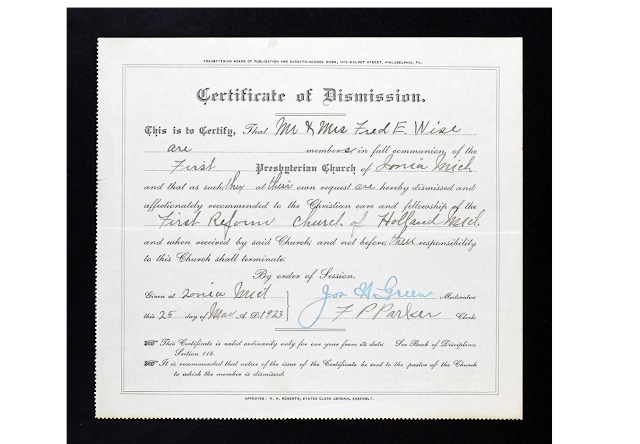
Document Decoding: Fred Wise and Jeanette Harkema's Church Transfer

In the Protestant world, church transfers are nothing unusual. It was a custom, at least to my maternal grandfather's generation, to marry in the wife's church. That's why my grandparents married in the Methodist Church, despite my grandfather being RCA. When Protestant families moved, they often had to switch congregations. In or around 1923, my great-great grandparents Fred Edwin Wise Sr. and Jeanette Gertrude Harkema moved from Ionia, Michigan to Holland, Michigan. Ionia County is two counties east of Ottawa County (where Holland is), so it made sense for the Wise's to switch congregations. However, when they moved, they also switched denominations!


According to this document, which was found in "U.S., Selected States Dutch Reformed Church Membership Records, 1701-1995", Mr. and Mrs. Fred E. Wise were members in full communion of the First Presbyterian Church in Ionia. They had probably been members for a few years, as the family was living in Ionia in the 1920 Census. The record goes on to state that at their own request, they are dismissed from the congregation and recommended to the "Christian care and fellowship" of the First Reformed Church of Holland. This order was given at Ionia on March 25, 1923. Once the family had moved to Holland, they began attending First Reformed, an RCA congregation where my family has deep roots. This was probably up to at least the time of Fred's death four years later, because when she died in 1951, Jeanette was attending Prospect Park Christian Reformed Church- yet another Protestant denomination!

Friday, September 17, 2021

Obituary Observations: Jeanette Gertrude Harkema of Holland, Michigan (1895-1951)

While going through one of my grandfather's genealogy binders the other day, I came across the obituary of my great-great grandmother, Jeanette Gertrude Harkema (1895-1951). I do not believe I've ever read this obituary, as it wasn't transcribed on my family tree. Jeanette seems to have led an interesting life:

Mrs. Jeanette G. Wise, 55, of 101 East 25th St., died Saturday in Holland hospital where she was admitted Wednesday. She had been ill two years. 

She was born in Holland and educated in local public schools. She was a member of Prospect Park Christian Reformed church, a Gold Star mother and a member of the American Legion Auxiliary. 

Her husband, Fred E. Wise, to whom she was married Feb. 14, 1912, was electrocuted in a power accident in 1927. A son, Robert Wayne, was killed by lightning while camping at Holland State park in the summer of 1942. Another son, Lt. John H. Wise, was killed in a plane crash while serving with the U. S. Air Corps in 1943. 

Surviving are two daughters, Mrs. Tim Smith and Mrs. Marvin J. Ver Hoef; three sons, Harold J., Fred E., Jr., and Kenneth P., all of Holland; 25 grandchildren and two great grandchildren; her father, William R. Harkema; her mother, Mrs. Jennie G. Atman; two stepsisters, Mrs. Henry Dorn of Holland and Mrs. Helen Belyea of Los Angeles, Calif. 

Here are some of my observations:
  • The address of her residence is recorded, 101 East 25th Street. This part of town seems to be over by Holland Hospital, but I am not entirely sure. Photos of the house come up on Google Maps, but I don't know if the house looked the same when Jeanette lived there. 
  • I wonder what kind of illness Jeanette had, and what her cause of death was? Her death certificate is something I should look into finding, to uncover what kind of illness it was. I wonder what it was like living with it for two whole years. 
  • If she was born in 1895, she likely graduated high school around 1913. I wonder if she attended Holland High School? And if so, if any yearbooks might exist which would include a photograph of her? This is something to look into next time I visit the Herrick Library.
  • Jeanette is now my 5th CRC ancestor I've discovered in less than two weeks, after previously being unaware of any CRC heritage. I don't know if she was Christian Reformed when my great-grandmother Gertrude was growing up, but at least by the time she died she was Christian Reformed. This congregation, Prospect Park, doesn't seem to exist anymore. 
  • The fact that Jeanette was a Gold Star mother is something very sad, but honorable. Losing a child in the service is heartbreaking and I cannot imagine how much suffering she went through. 
  • As a member of the American Legion Auxiliary, Jeanette must have been very active in honoring her son's service, and I imagine she was quite patriotic. The ALA seems to be composed of female relatives of veterans, and Jeanette certainly fell into this category. 
  • It is interesting to see an obituary include a marriage date. The date is accurate (I have their marriage record), but it's still interesting to be included. 
  • Losing a husband after 15 years of marriage in a shock electrical accident must have been extremely difficult for the young family to bear. She definitely lived a tragic life, but must have been a very strong woman to endure all of this. 
  • I knew someone in the family was killed by a lightning strike, but I didn't remember who. The obituary confirms it was a brother of my great-grandmother Gertrude, Robert Wayne. 
  • Her son, Lieutenant John Harter Wise (named after his grandfather, a Civil War Veteran), is the relative mentioned earlier who died in the service. As the obituary states, he died in a plane crash while serving in the Air Corps. This must have been a very tragic loss for the family and I can only imagine her grief upon being informed.
  • Jeanette's parents both outlived her, which is a very interesting fact. I don't know the reason they divorced, but losing a daughter hopefully brought them together at least a little bit for the funeral. 
  • I wonder who the stepsister's parents were? 
Reading this obituary, and pondering her life story, increase my admiration for my great-great grandmother. Oh, what a tragic life she endured! But because of it, she was likely an incredibly strong woman. Rest in peace!

Monday, September 13, 2021

My World War II Ancestors

The most recent war that my family fought in, unless you count the bloodless Cold War, was World War II. Both my paternal grandfather and my great-grandfather fought in World War II, and both of their stories deeply impact me today. Their stories: 
  • Luther Allen Saddler Jr., paternal grandfather: He enlisted in the US Army on August 31, 1943, at Huntington, West Virginia, and had the service number of 35773482. Not much is known about his service except for little bits and pieces. On October 30, 1943, the Bluefield Daily Telegraph reported that Pvt. Luther Saddler had been transferred from Fort Benjamin Harrison, Indiana to the 16th armored division at Camp Chaffee, Arkansas for basic training. During the war, he served in France and Germany. He was part of the 987th Field Artillery Battalion, and was a TEC 5 (Technician 5th Grade, or Tech Corporal). During the war, he had an army buddy named Keith. He must have been close to him, as my father was given the middle name of Keith after him. When he died, he had a military funeral. My paternal grandmother remembers that the funeral was held inside the church, and when they got to the cemetery, the American flag was draped on his casket, taps were played, and they shot cannons. 

  • John Washington Winn Jr., great-grandfather: His service is much better known. He enlisted November 5, 1940 and was discharged October 16, 1945. He served in Battery A of the 474th AAA. He fought at D-Day and at the Battle of the Bulge, and possibly participated in the liberation of Mittlebau-Dora Concentration Camp. He received many awards for his service, including 5 commendations for bravery, a Good Conduct medal, a medal for Sharpshooting, and most notably, a Purple Heart. He drove a Sherman Tank under recommendation from General Eisenhower. He was originally a Private, then a Corporal, and then a Staff Sergeant, but he was demoted and left a Private 1st Class. He almost froze to death in the mountains and got frostbite in his feet, and was hit in the leg with shrapnel. He drove a tank and he parachuted. He stormed a gestapo base and took home a photo of children saluting Hitler as a war prize, although this photo was later stolen. When he got back from the war, he threw his medals overboard. He didn't want them, as the war was extremely traumatic. He barely spoke about it. Evidence of how traumatic it was? He was one of only three men who came back alive from his original battalion. And he was the only one who came back with all his limbs intact. 
For those wondering why my great-grandfather was demoted to a Private? The Allies were trying to take a hill and the Germans kept waiving the white flag. When the Allies went to take over, the Germans would shoot them. The Allies were told not to shoot because of the white flag. He told his men to shoot them regardless if they waived the white flag.  They waved and his men shot on his orders.  This was a violation of the direct order that he had not to shoot.  He was brought in after the incident and was told that he had to apologize to his senior officer.  He said that he would not apologize to the SOB and didn't know that the guy was sitting in the back of that room. He was stripped of his rankings. 

RIP to everyone who died in World War II fighting fascist aggression and genocide. 


Credit to my great-aunt Michelle for these photos